Tuesday, October 9, 2012

VIDEO - A TWO-HORSE JOURNEY FROM CANADA TO BRAZIL

VIDEO - https://vimeo.com/50557143

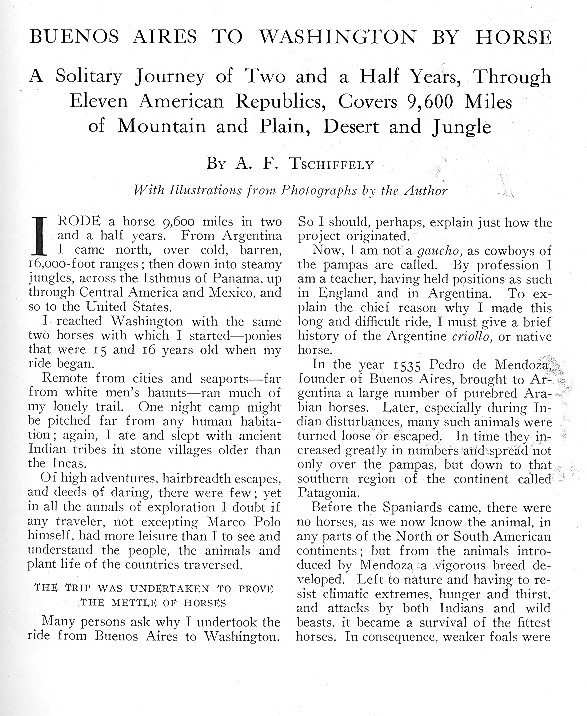
On July 8, 25-year-old journalist Filipe Leite straddled one of his two horses and rode out of the Calgary Stampede under the escort of the Royal Mounted Police to start a 10,000-mile, two-year-long, 12-country journey that he hopes will end on his family’s ranch in Brazil. To understand the motivations for the cowboy's quest, it helps to start with his birth. His father, a cowboy, named him Filipe because it means friend of horses in Portuguese. He rode a horse before he could walk. As a little boy, his father told him the story of Aime Tschiffely, a Swiss schoolteacher who decided to ride from Argentina to New York City in 1925 on a pair of horses. Tschiffely rode over 16,000-foot mountain ranges, down into humid tropical jungles, and slept in Indian villages on his way through Central America. He didn't make it to New York City, but landed in Washington D.C., where he was greeted at the White House by President Calvin Coolidge in 1928. “Of high adventures, hairbreath escapes, and deeds of daring, there were few; yet in all the annals of exploration I doubt if any traveler, not excepting Marco Polo himself, had more leisure than I to see and understand the people, the animals, and plant life of the countries traversed,” said Tschiffely in an article about the expedition.

Leite said Tschiffely's journey inspired him. The Brazilian hopes to chronicle his expedition in a documentary. For now, he is resting in Delta, Colorado, roughly 1,000 miles from his start in Canada. He estimates it will take him another a year and nine months of riding before he arrives home at his family’s ranch in the small town of Espirito Santo do Pinhal, Brazil. “My horses will be retired there where they will enjoy fresh water and green grass for the rest of their days,” says Leite. “I'm giving the to my little sister. She's six-years-old now and will spoil them to death.”

We caught up with the cowboy by e-mail to find out a bit more about his journey.

From the road Photo: @filipemasetti on Instagram

WHO: Filipe Leite, a 25-year-old journalist who grew up on a ranch in Brazil.

WHAT: A 10,000-mile, 12-country journey from Calgary, Canada, to Espirito Santo do Pinhal, Brazil, on two horses. Leite travels an average of 20 miles a day and rides for four days straight before resting for two days. He sits in the saddle for about 10 hours a day, switching steeds when he needs to. In cities, he stays at rodeo grounds. In the country, he stays at ranches or farms. The toughest part of his journey so far has been a four-hour walk in the dark through Yellowstone. “I thought I was going to get mauled by a grizzly bear,” says Leite. “It was the worst.”

WHEN: Leite left Calgary on July 8, 2012 and expects to arrive at his family’s ranch in Brazil during the summer of 2014, hopefully in time for the Olympics.

WHY: “The trip was a lifelong dream. I hope to inspire others to follow their dreams. I want to show the world that we can do anything we put our minds to, even if it seems as insane as riding horseback 10,000 miles from Canada to Brazil. I also hope to show how we are all inherently the same—we all want to love and be loved. As a journalism graduate, I also knew I wanted to do a documentary within the Americas that focused on the dichotomy between rich and poor while also highlighting how similar we all are—regardless of religion, creed, or social economic background. Travelling horseback is perfect for this because it allows you to really live with the people in all of the places you pass through. Because I need help in order to find food, water, and the best routes for my horses, I am in constant contact with locals. They open their ranches and farms for my horses and I and while sitting around the dinner table with them I get to learn so much.”

SPONSORS: Copper Spring Ranch, Mellohawk Logistics, and Outwildtv

FOLLOW ALONG: Outwildtv, @FilipeMasetti on Twitter, Journey America on Facebook, and@FilipeMasetti on Instagram

—Joe Spring
@joespring
facebook.com/joespring.1

Monday, October 1, 2012

NOAA National Weather Service "gets it" with new 'one-click' weather graphics

KUDOS to NOAA's NWS for making it EZ!!!

1.) Point your browser to one url: http://www.weather.gov/
2.) Then click a specific map location for weather information.

Saturday, September 15, 2012

A Backcountry Birthday Adventure in Alaska with a helicopter, a chainsaw and a bear gun


Mike Overcast, operations manager of the Tordrillo Mountain Lodge in Alaska, prepares to lead a group of anglers down Talachulitna Creek armed with colorful flies and a bear gun. | Brett Prettyman/The Salt Lake Tribune)


I have had some pretty amazing birthdays, but I doubt any will ever top spending my 44th in Alaska. I've returned from a two-week trip to Alaska based around the Outdoor Writers Association of America annual conference. I serve on the board of directors of OWAA and "had" to be at the conference. Knowing that, I took some time to plan my first trip to the state I have dreamed of visiting since I was 10 years old.

The trip included many forms of transportation including: motor home, canoe, ATV, raft, float plane, train and helicopter. Lodging ranged from the aforementioned motor home to an off-the-grid spectacular cabin to a room at Chena Hot Springs Resort to the Tordrillo Mountain Lodge.

I spent nearly every minute of the two weeks with good friends Mark Freeman from Oregon and Reed Sherman, my fishing buddy who produced all the fishing and wildlife videos on the Tribune YouTube account. Along the way I hooked up with other good friends: Bill Klyn, Mark Taylor, Tim Zink, Chris Hunt and all my old and new friends with OWAA.

Through all the planning I could not have picked a more fitting end to the trip or a better way to spend my birthday on Tuesday. Mike Overcast suggested Mark, Bill, Tim and I join him for a float trip down Talachulitna Creek above Judd Lake, where the lodge he operates is located. The Talachulitna River, well known for producing big rainbows, starts out of Judd Lake right where the Tordrillo Mountain Lodge sits. We quickly agreed to the adventure as all of Mike's suggestions had reaped enormous fishing rewards to that point.

Tuesday morning we loaded the helicopter with inflatable rafts and our fishing gear and took the incredibly scenic flight to the launch. I took three steps out of the helicopter and landed on a grizzly footprint. I had thus far gone without seeing a bear in Alaska and I later told Mike I was both relieved and disappointed to not have seen one. I carried bear spray during the entire trip in Alaska - well, not in the motor home or in the train - and Mike was sporting a huge pistol during our float. It was tucked in a holster on his chest along with a colorful assortment of flies.

The first spot we stopped to fish the creek was loaded, and I mean chock full, of sockeye salmon. The banks on both sides of the river were stamped with bear tracks bigger than my face. We soon started to spot big piles of what I called fast-food remnants from the bears. Not bear scat, but big piles of partially consumed sockeye littered the banks. I figured if I was ever going to see a bear in Alaska that this was the time and that it was more than likely to be a close encounter.

We fished through and behind the sockeye seeking Dolly varden and rainbow trout that collect with the salmon to dine on the eggs leaking out or being laid. I found it a bit hard to concentrate with decades of grizzly attack stories seeping out of my brain. Nonetheless, I still managed to hook up with big Dollies and 'bows. A little farther down the creek we ran into our first log jam. It wasn't too big, so we just pulled the rafts over the log and crawled back in to continue on our way. Mentions of Lewis and Clark were shared and laughed about, but any similarities disappeared when we hit the next log jam.

We hit a good fishing hole and after we started casting Mike walked down to explore the creek. He came back a few minutes later, grabbed something out of the raft and headed back downstream. My fears of encountering a grizzly, at least for the next few miles, faded as Mike fired up the chainsaw and jumped on the logjam. Five minutes on the chainsaw easily equalled a hour's worth of my measly "Hey Bear!" call. We ended up using the chainsaw several times saving my voice from getting hoarse from all the yelling.

I have never felt so far away from the chaos of the world as I did on Tuesday. Feeling that way cleared my mind in a way I've never experienced and lifted me spiritually. I already crave to experience that feeling again.

Back at the lodge that evening the staff brought out candles, luckily only three, on dessert and my buddies, the other visitors and the folks at Tordrillo Mountain Lodge sang happy birthday to me. A birthday never tasted so sweet, although I must confess that I really was missing my family at that point.

Flying back to Anchorage in the float plane on Wednesday I scanned the terrain below us very carefully for a bear. I was suddenly desperate to see one, but we hit the outskirts of town with no luck. I guess that means I'll have to return to Alaska.

http://www.sltrib.com/sltrib/blogsfishing/54898321-83/bear-alaska-mike-trip.html.csp


Monday, September 10, 2012

Odyssey Marine recovers silver from the Gairsoppa

08.20.12.silver

By any historic measure, German U-boat activity during World War II in the North Atlantic was a persistent and deadly fact of life.

But the German torpedo attack on a 412' steel-hulled cargo ship was particularly galling: not only was it a British ship but it also was most likely carrying in excess of 2,000 silver bars.

Just over 70 years after the SS Gairsoppasunk out of sight about 300 miles from Galway, Ireland, a recovery operation conducted by Tampa-Fla.-based Odyssey Marine Exploration has retrieved some 48 tons of silver bullion at a depth of roughly three miles.

Conducting the operation under contract with Britain’s Department for Transport, Odyssey Marine has so far retrieved 1,203 silver bars that have since been transported to a secure facility in the UK. The company will now launch a subsequent Gairsoppa recovery operation to hopefully pick up what it left behind. It is scheduled to be completed by the end of this year.

“The success of this record-setting project proves that the Odyssey team can surgically cut through secure areas of a modern shipwreck to recover cargo in the extremely deep ocean with the use of robotics,” said Odyssey President and COO Mark Gordon. “By proving this we can now entertain a host of other shipwreck projects that were previously unattainable due to depth.”

The recovery operation was officially launched in May, coming on the heels of a series of reconnaissance dives conducted by the company earlier in the year.

Odyssey officials now hope to buttress the 1.4 million-oz. Gairsoppa recovery with the retrieval of an estimated 600,000 ozs. of silver onboard the SS Mantola — a second shipwreck recovery operation that is expected to reach its conclusion late this autumn. The Minolta was a 450' British-flagged steamer, which set sail from London on Feb. 4, 1917, carrying passengers and cargo — including a shipment of silver — to Calcutta, India. On Feb. 8, 1917, The vessel was torpedoed by a German submarine.

In a statement, Odyssey CEO Greg Stemm, said, “Our success on the Gairsoppa marks the beginning of a new paradigm for Odyssey in which we expect modern shipwreck projects will complement our archaeological shipwreck excavations.”

The operation has been framed by a public/private contract between Odyssey and the British government, which requires the company to bear the risk of the work while also retaining a percentage of the net saved value of the Gairsoppa haul after expenses.

Gordon contends the early success of the Gairsoppaoperation is proof that “our government partnership model works.”

“We took the risk of the search and recovery on this project,” said Gordon, “and will be rewarded with the repayment of expenses plus 80 percent of the net salved value of the silver recovered.”

The British government, meanwhile, “will retain 20 percent of the net salved value at no risk or expense to their taxpayers,” added Gordon.

Odyssey specializes in what is described as “archaeologically sensitive exploration” and the global recovery of deep-ocean shipwrecks.

http://www.workboat.com/imagedetail.aspx?id=18062


Wednesday, August 29, 2012

WORLD RECORD DATED 20120829 - CAPTAIN DAVID COWPER IN M/V POLAR BOUND is the first to navigate the original Northwest Passage since discovery in 1851


File:Cowper stromness.jpg
Date: 20120829 1200hrs - Position 74 21 62N -124 57 36W

U.K. Captain David Scott Cowper, age 70, aboard M/V POLAR BOUND has become the first in history to successfully navigate solo through McClure Strait over the top of Banks Island on the original Northwest Passage route discovered by Captain Robert McClure in 1851 aboard HMS INVESTIGATOR.


Captain David Scott Cowper has done what no one else in the last 161 years could - not even the 1,005 foot, 43,000hp Icebreaker SS MANHATTAN could not transit through the sea ice - she had to turn around in McClure Strait - Captain Cowper achieved his accomplishment with his specially built aluminum 48 foot M/V POLAR BOUND powered with a single 170hp Gardner 8LXB engine carrying 10 tons of diesel fuel.

Captain David Scott Cowper now becomes the only person to complete four solo Northwest Passages and is on his seventh(?) world solo circumnavigation. Might this be a Polar circumnavigation?  Time will tell...

My hat goes off to you!!! A job well done!!!


GOD SPEED POLAR BOUND AND HER GOOD CAPTAIN!


File:Cowper fortross 2004.jpg

Wednesday, August 22, 2012

South Boston resident completes Patagonia expedition


Matthew “Matt” Morris, 21, of South Boston, recently completed an 80-day expedition traveling in Patagonia with the National Outdoor Leadership School based in Lander, Wyo.

The first section of the semester in Patagonia, Morris and his coursemates completed a 173-mile sea kayaking expedition. The expedition was self- sufficient for 30 days—traveling, camping and living together. The course was comprised of five instructors and 16 students and encountered minks, albatross, blue whales, otter, sea lions and other animals.

The next section of the semester, Morris spent 30 days in the mountains of Patagonia. He and his coursemates traveled 68 miles mostly off trail. They also ascended the peaks Punta and Punta Caicaivilu.

The group also participated in ice climbing, mountaineering, cultural interactions with local people and four days of independent travel.

The South Boston resident and his coursemates were exposed to several leadership opportunities including being the leaders of the day throughout the expedition.

The group had a chance to fish in a very remote area where they caught some big rainbow trout. By the end of the course, students were leading their own small expeditions.

Morris graduated from his National Outdoor Leadership School course prepared to lead an expedition of his own.

The course equipped Morris and fellow students with the outdoor skills to safely and responsibly travel in the backcountry, coupled with the leadership skills to do so with others.

Morris is the son of Dr. and Mrs. Mark Morris of South Boston.

Founded in 1965 by legendary mountaineer Paul Petzoldt, National Outdoor Leadership School is the leader in wilderness education and sets the industry standard for responsible, high-quality educational expeditions.

National Outdoor Leadership School provides an awe-inspiring, transformative experience that develops active, positive leaders with lifelong environmental ethics and outdoor skills to more than 10,000 students each year.

A private nonprofit school, National Outdoor Leadership School runs 10-day to school-year-length courses on four continents.

National Outdoor Leadership School students, ages 14 to over 70, explore the most remote wilderness in the Rocky Mountains, Idaho, Pacific Northwest, Southwest, Alaska, Western Canada, Mexico, Patagonia (Chile), India, Australia, New Zealand, Brazil and Baffin Island have to offer.


Tuesday, August 14, 2012

Adventures at Sea


A Florida science teacher joins USF researchers continuing their study on the impact of the Gulf oil spill. Follow the blog.


From USF News


ST. PETERSBURG, Fla. (Aug. 13, 2012) – The aftermath of the Deepwater Horizon oil spill has become one of the world’s most significant scientific research efforts, but it won’t take years for the scientific discovery to filter its way into local school classrooms.


Patty Smukall, a veteran science teacher from Wekiva High School in Apopka, Fla., today becomes the first teacher to join in the University of South Florida’s spill research as she becomes a member of the scientific crew aboard the R/V Weatherbird II for a 13-day research cruise to areas of the Gulf impacted by the spill.


Smukall will share her experiences from aboard the Weatherbird II on the USF blogAdventures at Sea as she works with USF scientists to examine all aspects of the spill.


The voyage is part of USF’s C-Image project – an $11 million, three-year effort to document the impact of the massive spill on the Gulf ecosystem. USF is leading a group of scientists from 16 institutions, spanning five U.S. states and three countries, including the Florida Institute of Oceanography – a cooperative of the state’s public and private marine science research centers.


Researchers are focusing on two themes related to the spill: understanding the physical, chemical, biological and geological processes that control the dispersion and fate of oil and gas released during a deep-sea blowout; and understanding the impacts of the Deepwater Horizon spill on the marine ecosystem.


Smukall, who graduated in 1977 with a degree in zoology from USF, teaches juniors and seniors in marine science. Her teaching career includes stints at zoos and aquariums, including Sea World and Mill Mt. Zoo.


“I am hoping to inspire many of my students, who are generally in 11th and 12th grade, to consider a career in some field of science or at least to want to learn more about the marine environment,” she said just before heading out on the research voyage.


 “I think that many students feel that seeking a science career is out of reach for them and, hopefully, watching the research going on, and seeing their teacher right there in the midst of it will bring it closer to home and seem more obtainable.”

Wednesday, August 8, 2012

30 Young Blake explorers set off on historic journey


The first Young Blake Expedition – to New Zealand’s remote Kermadec Islands –weighed anchor this morning, with 30 outstanding teenage explorers aboard HMNZS Canterbury ready for the adventure of a lifetime.


The 30, from all over New Zealand, were selected in May to go on the Young Blake Expedition, with the aim of increasing the understanding of the marine reserves and the planet’s oceans.
HMNZS Canterbury left Devonport Naval Base at 11:30am, before heading for the open sea on the voyage north, which is expected to take two days. The Governor-General, Lt Gen The Rt Hon Sir Jerry Mateparae, and the Deputy Chief of Navy, Commodore Wayne Burroughs, farewelled the expedition on its 12-day journey.
Students will contribute to New Zealand’s scientific knowledge by helping with shark tagging, dolphin DNA sampling, and foliage collection. They will get to observe the Kermadecs’ unique flora and fauna, and learn about one of New Zealand’s little-visited northern outposts.
They are joined by 26 crew members – an outstanding group of leaders in environment, government, business and science. On board the expedition are also teams from the Department of Conservation and the Royal New Zealand Navy.
The Young Blake Expedition was announced last December by the Governor-General, Sir Jerry Mateparae, on the 10th year anniversary of Sir Peter Blake’s death to continue his legacy of inspiring the next generation of leaders, adventurers and environmentalists.
Sir Peter Blake Trust chief executive Shelley Campbell says the Expedition fulfills Sir Peter’s vision for our most dynamic teenagers to be challenged, and inspired to embrace their potential.
“Each one of the 30 deserves their place, and brings unique skills and personality to the team which will undertake this amazing adventure,” says Shelley Campbell.
“This life-changing experience aims to inspire young environmental leaders encouraged to make a difference in each of their communities.”
The students – 18 girls and 12 boys – come from as far north as Whangarei, and as far south as Limehills in Southland.
Nicholas Humphries, 16, of Fiordland College in Southland says: "I just can’t believe that very soon I will be going to one of the most pristine environments in the world. It is just an amazing opportunity that I'm so grateful that I have been selected for. I just can’t wait till I jump into the water for the first time and see all the sea life!"
He is one of two participants in Kids Restore New Zealand projects, in association with the Air New Zealand Environment Trust, who were selected. Air New Zealand Environment Trust flew all 30 student voyagers to Auckland for the start of the Expedition.
The Young Blake Expedition is being led by The Sir Peter Blake Trust in association with the Ministry for the Environment, the Royal New Zealand Navy, Department of Conservation, Air New Zealand Environment Trust, Pew Environment Group, Experiencing Marine Reserves, LEARNZ, and the Air New Zealand Environment Trust.

Northland
• Jack Hamilton, 16, Whangarei Boys’ High School
• Ruahei Demant, 17, Mahurangi College
Auckland
• Isabella Lenihan-Ikin, 15, Western Springs College
• Susanna Lees Watts, 16, Auckland Girls’ Grammar
• Gomathi Rajasekaran, 17, Manurewa High School
• Melania Napa’a, 16, Sir Edmund Hillary Collegiate
Waikato
• Olivia Jay, 17, Waikato Diocesan
• Patricia Harrison, 17, Hillcrest High School
Bay of Plenty
• Elijah Koopu, 16, Rotorua Boys’ High
• Freya O’Sullivan, 16, Tauranga Girls’ College
Hawke’s Bay
• Rose Mickleson, 17, Woodford House
Poverty Bay
• Logan Candy, 16, Gisborne Boys’ High School
Taranaki
• Jamie Darbyshire, 17, Hawera High School
Wanganui
• Melissa Churchouse, 16, Wanganui Girls’ College
Manawatu
• Eilis Donnelly, 16, Palmerston North Girls’ High School
• Rhiannon Scott, 17, Taihape Area School
Wellington
• Tre Ratahi, 17, Upper Hutt College
• Asia Brownlie, 15, Wellington Girls’ College
• Lily Pryor-Rodgers, 18, Kapiti College
• Felix Bornholdt, 16, St Patrick’s College
Marlborough
• Daniel Goldthorpe, 18, Marlborough Boys’ College
West Coast
• John Whitcombe, 17, John Paul II High School
Canterbury
• Alexander Gregory, 16, Christ’s College
• Lucy Tothill, 16, St Margaret’s College
• Craig Smith, 16, St Thomas of Canterbury College
• Anna Clark, 16, Hurunui College
Otago
• Hamish Darling, 15, John McGlashan College
• Rebecca Vella-King, 17, Logan Park High School
Southland
• Nicholas Humphries, 15, Fiordland College
• Sophie Smith, 17, Southland Girls’ High School
Notes to editors about the crew:

Crew/Experts selected by the Sir Peter Blake Trust 
• Don Robertson - Chief Operating Officer
• Chris Mace - Expedition Team Leader
• Andrew Berry – Marine Operations Director
• Hannah Prior - Programme & Logistics Director
• Mark Weldon – Expedition Team Leader
• Sam Johnson – Expedition Team Leader
• Sheelagh James – Expedition Doctor
• Michael Moyes – Expedition Team Leader
• Paul Scott – Teacher/Educator & Expedition Team Leader
• Libby Liggins – Snorkeling Leader & former Antarctic Youth Ambassador
Experiencing Marine Reserves
• Samara Nicholas – Snorkeling Director & Blake Leader
• Steve Hathaway – Underwater Cameraman

Experts selected by Pew Environment Group
• Helen Bostock – Marine Geologist
• Stephen Ullrich – Marine Collector & Architect
• Rochelle Constantine – Marine Mammal Specialist
• Clinton Duffy – Shark Expert
• Bruce Foster – photographer & film maker
• Isaac Sutherland – Ngati Kuri representative
• Rebecca Priestley - columnist for The Listener
LEARNZ – virtual field trips
• Peter Sommerville – Virtual Field Trip leader & correspondent
• Andrew Penny - Virtual Field Trip leader& correspondent
Media
• Peter Cronshaw - TVNZ
• Charles Toogood - TVNZ
• David Pierce -TVNZ
• Virginia Larson - editor of North & South

About The Young Blake Expedition
The 30 students on the Young Blake Expedition will be accompanied by a crew of subject experts, scientists, artists, educators, communicators and leaders. The Kermadec Islands and rocks are 800-1,000km north-east of New Zealand. The 13 volcanic islands are a nature reserve managed by the Department of Conservation (DOC). Four DOC staff and up to five volunteers are based on Raoul, the largest island. The 745,000ha of ocean surrounding the Kermadecs are protected as New Zealand’s largest marine reserve.
The expedition crew will have the opportunity to snorkel and gain an understanding of the rich marine life of the Kermadecs. They will experience life on Raoul Island and gain an insight into the work of the DOC personnel, the Kermadecs' history, and the group’s wildlife and plants – many unique to the islands.
The first Young Blake Expedition was announced last December on the 10th anniversary of Sir Peter Blake’s death to continue his legacy of inspiring the next generation of leaders, adventurers and environmentalists.
The expedition blog can be followed here: www.youngblakeexpeditions.org


Monday, August 6, 2012

An Expedition to the Russian High Arctic

http://ireport.cnn.com/docs/DOC-822711

An Expedition to the Russian  High Arctic


CNN PRODUCER NOTE     konacraig, an avid world traveler and wildlife photographer, joined 80 other thrill-seekers on an expedition to the remote Arctic islands of Franz Joseph Land. The group experienced the sights and sounds of the Arctic, seeing hundreds of walruses, witnessing bloodied polar bears eating carcasses, and enduring extreme, below-freezing temperatures. "We sailed through dense fog, large swells and heavy winds," he says. "It was an expedition of like minded people who care about the environment and seek new adventures."
stein0726, CNN iReport producer
In July, 2012 myself and 80 fellow travelers boarded a Russian Icebreaker in the port city of Murmansk to explore the remote islands for Franz Joseph Land located above the Arctic Circle. 

Leaving at midnight we passed by the Russian Naval installations which guard Murmansk and sailed through the Barents Sea arriving in the the islands 2 days later. 

The weather was great. Air temperature 0 degrees F, water temperature just above freezing. 

The ship readied its helicopters which we would use to shuttle to land, explore the sea ice and serve as a method to scouting ways through the polar ice pack. 

For the next 10 days we visited abandoned polar research stations, camps where early explorers wintered in and places where explorers survived until help came and saved them when their ships were caught in the ice pack. 

We were fortunate to have some great sightings of polar bears, walruses, arctic flowers, glaciers and icebergs. 

Attached are some of the photos from this expedition.

An Expedition to the Russian  High Arctic

An Expedition to the Russian  High Arctic

An Expedition to the Russian  High Arctic

An Expedition to the Russian  High Arctic

An Expedition to the Russian  High Arctic

An Expedition to the Russian  High Arctic

An Expedition to the Russian  High Arctic

An Expedition to the Russian  High Arctic


Friday, August 3, 2012

New National Geographic cruise to circumnavigate Iceland

http://travel.usatoday.com/cruises/post/2012/08/iceland-cruise-circumnavigation-national-geographic/812571/1?csp=34travel


Is Iceland on your bucket list? A new small ship expedition planned for next year by National Geographic Expeditions offers the chance to circle the entire island in just over a week.
Dubbed A Circumnavigation of Iceland, the eight-night sailing on Lindblad Expeditions' 148-passenger National Geographic Explorer will kick off July 11, 2013 in Reykjavík, Iceland and focus on the country's many geological wonders and natural areas.
National Geographic says highlights of the voyage will include walking on lava fields and ice sheets, visiting hot springs and waterfalls and birding in the Arctic Circle. Kayaking into fjords and serene bays, and hiking along remote stretches of the Iceland coast also is on the schedule, as well as visits to small coastal towns.
Fares for the trip start at $7,990 per person, based on double occupancy and not including airfare.
A Circumnavigation of Iceland is just one of several new small ship expeditions that National Geographic is rolling out for 2013. Also new is a 17-day trip into the Arctic Circle called Arctic Quest: Greenland and the Canadian High Arctic and a 12-day trip in the region called Along the Viking Trail: Iceland to Greenland. More information is online atnationalgeographicexpeditions.com.