So throw off the bowlines. Sail away from the safe harbor. Catch the trade winds in your sails. Explore. Dream. Discover. - Mark Twain, American Author
Sir Ranulph expedition ship arrives in Canary Wharf By Rob Virtue on November 30, 2012 11:50 AM |
A ship aiming to be part of the first ever trans-Antarctic winter crossing has docked in Wood Wharf.
Led by explorer Sir Ranulph Fiennes, the Coldest Journey expedition will see the specially adapted SA Agulhas travel nearly 2000 miles in almost complete darkness and in tempretures of minus 90 degrees celcius in a never before attempted challenge.
During its time in Canary wharf, the ship will be loaded with vital equipment and supplies for the journey.
The project team which includes Brian Newham, Ian Prickett, Spencer Smirl, Richmond Dykes and Dr Robert Lambert will carry out scientific experiments whilst on the ice and also raise money for Seeing Is Believing, an internationl charity focused on tackling avoidable blindness.
Sir Ranulph said: "Seeing is Believing is a cause very dear to me. Having experienced temporary snow blindness myself in the past, I've had a glimpse into what it would be like to lose my sight. It's absolutely frightening. I was moved by the challenge of eliminating avoidable blindness and I wanted to be a part of it.
"The Coldest Journey has the potential to make a real impact towards the goal of eliminating avoidable blindness around the world."
The journey will begin on 21 March 2013 at the winter equinox and could be 68-year-old Sir Ranulph's final expedition.
In 100 years or so, when Google’s autonomous robo-historians write the book on their fleshy predecessors, they will no doubt try to explain why we blew it on climate change. Why, despite decades of ever-more-definitive evidence, did the human species not take even the most basic of measures to avoid a catastrophe?
They will find plenty of blame to pass around. Our political systems, they will observe, just weren’t up to the diplomatic challenges of mustering a multinational effort — we couldn’t agree on whose fault it was, who should pay to fix it, even whether we should bother trying. Our brains proved ill-equipped to process the gravity of a long-range threat until it was too late. And our news media, the storytellers to whom this message was entrusted, were too easily distracted by more lurid dramas.
We didn’t see it coming, even though, on every other level, we knew it was.
This, as nature photographer James Balog tells us in the documentaryChasing Ice, is essentially a failure of imagination. Unless you have a glacier in your backyard, the earliest effects of a warming planet have so far appeared to most of us only intermittently, a signal lost in the noise of the daily weather.
Balog’s response to this perceptual disconnect is called the Extreme Ice Survey: He sets up dozens of stationary cameras aimed at glaciers in Iceland, Greenland, Alaska, and elsewhere. The cameras shoot photos every 30 minutes during daylight hours, some 8,000 pictures a year. It’s the same photo-a-day technique that so many amateur documentarians have used to create those viral videos of receding hairlines, but on a geological scale.
The resulting time-lapse movie can condense months and years into a few mesmerizing moments. Now we can watch the canary in the coal mine as it expires.
“Melt” doesn’t really capture the awesome violence of what we’re seeing. Balog’s cameras look on as the flank of an Icelandic glacier “deflates,” crumpling into black-puddled nothingness like a giant decomposing animal. A crawling river of ice in Alaska turns into a raging torrent, speeding up before our eyes. Greenland’s Ilulissat ice sheet rolls over the landscape, an endless white blanket sloughing off into the ocean. It is, as the photographer says in the film, a “magical, miraculous, horrible, and scary thing.”
Chasing Ice, which was directed by Jeff Orlowski, saves most of these sequences for the film’s climactic third-act reveal, when we finally see the results of three years of labor by Balog and his team of young assistants. The first two acts are dedicated to the team’s admirable and occasionally moderately nail-biting efforts, as they scramble over various harsh landscapes installing their cameras, battling bad weather and technical foul-ups.
Balog, a veteran environmental photographer well-known for his work in National Geographic, is now pushing 60 and has a bum knee that’s starting to get in the way of the physical demands of his work. But, perhaps because his photos reveal something enormous and terrifying that’s happening at a planetary scale, it’s hard to get too worked up about the small-scale drama of his knee surgery. He isn’t the sort of obsessive weirdo whose outsize personality can carry a two-hour documentary. Essentially, he’s just a guy doing his job, a photojournalist drawn to the ice by the charge of his profession: to bear witness.
It’s possible that the whole EIS project doesn’t really have much to add to the science on Arctic melting (doesn’t satellite imagery reveal essentially the same phenomenon?). The wider arena of climate change policy is glimpsed only in passing; there’s a montage of assorted Fox News mockery of global warming, footage of hurricanes and floods, grave promises of extreme weather to come. And Chasing Ice has little to say on solutions, so stow your geoengineering schemeselsewhere.
The film’s achievement is fundamentally aesthetic. A sequence at the end showing an enormous “calving event” might be the most astonishing thing you’ll see all year. A lower-Manhattan-sized glacier spontaneously self-destructs into a boiling sea, rumbling and roaring like an angry god as it dies. It’s a triumph of disaster-movie spectacle, all the more haunting for being real.
It’s hard not to marvel at such visuals and wonder if some of that melted ice isn’t soaking someone’s basement in Staten Island now, or whether it’s coming into your basement next year. Balog’s work makes such powerful agit-prop because, unlike the ill portents delivered by other climate Cassandras, it delivers ground truth, not doomy speculation pegged to a deadline that still at least sounds far off.
As chilling as it is to read, say, the newest report from the World Bankon how unlivable we will likely render the planet by the end of the century, there’s still that slender thread of reassurance to cling to. Yeah, we’re cutting it close, but we’ve still got 88 years to get our shit together. As Chasing Ice shows, however, the clock might be ticking faster than it appears.
For a glimpse of what Chasing Ice has to offer, check out the trailer below. The film opened at film festivals earlier this month, and rolls out in theaters in major U.S. cities on Thanksgiving Day. (Find a full schedule here.)
David Dudley is a writer and editor who lives in Baltimore. His writing has appeared in the New York Times, the Daily Beast, and AARP The Magazine.
If you’ve spent much time in interior Alaska, you’re aware that the seasons go from full on summer to full on winter in a matter of only a few weeks. On one of the last weekends before the snow hit, my buddy JR and I took my boat out on the river for one last hurrah.
I had just fixed my jet unit after battering it while I was hauling my moose out of the bush, so I just couldn’t stand putting it away without one last good trip. This time we were in pursuit of the late-running coho salmon, or silvers as we call them.
After their long swim up the Yukon river, the silvers finally make it to their spawning grounds beginning in late September. By the time they get here, they aren’t the vigorous fighters they are in the ocean, and aren’t very good to eat, but they’re still a blast to catch. We took to a crystal-clear river dressed more for snowmobiling than boating, but it was chock full of fish, so we knew it would be a good day.
Before we got going, we had to spend half an hour letting my throttle thaw out and getting my steering cable broke loose. It was about 18 degrees and the moisture in my steering cable had frozen it solid! Soon enough, though, we were on our way, and shouting and pointing like kids as we zipped over schools of salmon. After a few minutes, we found a good spot to tie off, and we were catching fish in no time. We were fishing out of the boat using lures we call wiggle warts, which are basically just a shiny rattling crank bait.
Although the fish aren’t really feeding at this point in their journey, they are still very aggressive. The wiggle wart is a pretty obnoxious lure, and our basic technique was to pull it upstream past the salmon or hold it in the current right in front of them. There weren’t very many that could keep from biting it!
After pulling in 10 or 15 fish from this spot we pushed farther up river, and after only a few bends upstream we passed over a hole that had to have at least 200 salmon in it. We anchored up and started reeling them in almost every cast. After awhile we had to take a break for a cup of coffee and to break the ice off the guides on our fishing rods. We spent quite a bit of time just sitting there watching the salmon all around and under the boat. It’s easy for me to take this stuff for granted, living in a place like this, but just being out there is an amazing experience every time.
It turned out to be a great last run on the boat for the year. We caught and released about 50 salmon, and we were thankful to spend another day out enjoying Alaska.
The Russian bark Sedov is sailing towards the coasts of French Polynesia as part of its round-the-world voyage. The Sedov is retracing the route of the first Russian round the world expedition led by Ivan Krusenstern 200 years ago. Photo: Karina Ivashko The seafarer’s descendant Alexei Krusenstern is writing a book about Russian round the world voyages which should come out after the current expedition comes to an end. The Voice of Russia’s Karina Ivashko and Alexei Lyakhov report.
The bark Sedov set sail from Lieutenant Schmidt Embankment in St.Petersburg, which is known for a monument to Russian navigator Ivan Krusenstern. In 1802, Lieutenant Commander Ivan Krusenstern wrote a letter to Russian Emperor Alexander I with a proposal to mount a round the world expedition. The emperor found his arguments convincing. One year later, the two ships, Nadezhda and Neva, set out on a round the world diplomatic and research mission paving the way to a series of successful round the world trips by Russian navigators.
Ivan Krusenstern’s descendant, Alexei Krusenstern, a former doctor and now a businessman, is writing a book about Russian round the world expeditions covering a period from his famous ancestor’s expedition of 200 years ago to the current voyage.
"The book will tell readers about 19th century round the world trips. More than fifty such expeditions took place in the middle of the 19th century. Many expeditions were made in the early 20th century. In Soviet times, ships did not go on round the world trips, except for merchant ships. In 1991, the tradition of sending ships on round the world trips was revived and a whole number of vessels, including the Russian tall ship Kruzenshtern named after the famous seafarer, and the ships Pallada, Nadezhda, and now Sedov, are partaking in circumnavigation projects."
A separate chapter of the book will be devoted to the first circumnavigation of the globe. Thanks to a large number of illustrations, readers will be able to compare the way things looked two centuries ago with what they look now. The author will also speak about Russia’s influence on global navigation.
According to Alexei Krusenstern, round the world trips have a particular meaning for Russian people for a good reason.
"No other nation but Russia can boast that its seafarers come back to the Russian land being only halfway through a round the world voyage. After covering two oceans, they arrive at the Russian Far East. This could be why Russians are so keen on round the world expeditions."
The vast size of Russia, washed by three oceans, becomes tangible only on a round the world trip. A passion for seafaring runs in the Krusenstern family, Alexei Krusenstern says.
"At least five members of the Krusenstern family have made round the world voyages. As a seaman cadet, young Ivan Krusenstern distinguished himself in the war against Sweden in 1788 and was ordered to capture a Swedish flagship. When he boarded the enemy ship, he discovered that among those on board there were three Swedish lieutenants who were his cousins. One of them, Maurice Adolf von Krusenstern, became the leader of the first Swedish circumnavigation several years later."
Alexei Krusenstern was going to celebrate his 50th birthday at Cape Horn, on the Russian bark Sedov. However, he had to change his plans as his part of the Circumnavigation 2012-2013 Project, he says, is to present a complete layout of the book by the bark’s return from the months-long journey.
The REI Blog is following the progress of Expedition Denali as the all African American crew readies for their June 2013 summit attempt. Aparna Rajagopal-Durbin, field instructor and Diversity and Inclusion Manager from the National Outdoor Leadership School (NOLS) and cofounder of Expedition Denali, provides this update:
Picture a mountaineer. OK, what does your picture look like? I bet it is a rugged, leathery-faced white male in his late 30s to early 40s with wind-burnt cheeks and chiseled features. I bet you don’t picture the all African American members on Expedition Denali.
So why is it that so many of us picture white men when we think about mountaineering, or even outdoor adventuring in general?
Is it Hollywood characters such as Scott Glenn playing K2 specialist Montgomery Wick in Vertical Limit or Sylvester Stallone free soloing a cliff during a blizzard inCliffhanger? Is it our history books, which tout about the heroic deeds of Sir Edmund Hillary? Is it just how the sport began, as mainly the pastime of the privileged few who wanted to make their mark on history?
Or is it the media, which has largely failed to make reference to pioneers such as Alaska Native Walter Harper who made the first ascent of Denali in 1913, or the countless Sherpas who have ushered mountaineers to the highest points on earth?
Face it, it will take a major paradigm shift for us to see alpine mountaineering as more than rich white dudes gallivanting across the world to climb granitic monoliths in the Himalayas. But with Expedition Denali, I hope that maybe—just maybe—that highlighting the inspiring feats of a set of African American outdoor role models can get us part way there.
With Expedition Denali, the National Outdoor Leadership School (NOLS) will lead the first African American expedition to summit Denali—the highest peak (20,320') in North America—in June 2013, the centennial of its first ascent.
Through this expedition, our school aspires to develop role models who will inspire young people of color to get outside, stay active and fall in love with nature. A greater goal of the expedition is to engage a broader constituency in a public dialogue about diversity in the outdoors.
But more important than the actual expedition will be what is happening on the ground.
During the mountaineering team’s ascent, organizations nationwide such as Sierra Club and the YMCAwill lead youth and families on their own “10,000 Steps to Denali” (the approximately 5-mile round trip distance between High Camp and the Denali summit) in outdoor spaces near their homes in solidarity with the team and to commemorate this historic event. After the expedition, team members will visit with schools, organizations and church groups nationwide to directly connect with people of color.
The team’s journey began with rigorous training in Alaska’s Chugach Range, British Columbia’s Waddington Range, Washington’s Mount Baker and the Patagonian Andes. Now the team will continue to train and stay fit as we all eagerly anticipate June 8, when their Denali expedition begins.
Team member Adina Scott recently blogged about her Expedition Denali training for The REI Blog. Stay tuned for future posts from team members as they reflect upon the past months of preparing for Denali and the journey ahead.
A naval pilot is embarking on an ambitious expedition to circumnavigate the world non-stop in a specially-built ship.
If Lieutenant Commander Abhishek Tommy pulls off the adventure, he would become first Indian and the second Asian after Minoru Saito from Japan, to accomplish such mission.
Tommy will set sail from Mumbai on November 1 and is expected to take six months to circumnavigate the globe in his indigenously built vessel INSV Mhadei.
The expedition labelled as 'Sagar Parikrama II' is a sequel to 'Sagar Parikrama I' completed successfully by Commander Dilip Dhonde who had travelled 23,400 nautical miles for 165 days.
"This would be uninterrupted journey," Tommy told PTI at Verem Naval jetty near here.
As a naval pilot, Tommy had provided the shore support in Dornier aircraft to commander Dhonde during 'Sagar Parikrama I'.
Tommy will be carrying foodstock that is expected to last for about a year.
Mysore-based Defence Food Research Laboratory has produced the food provision that can last for months together without refrigeration facility for the second edition of the ambitious expedition.
The officer will be carrying gadgets that will give him access to satellite Internet, satellite telephony and access to email.
Terming his mission the "biggest adventure for any human being," Tommy said so far only 80 people have circumvented the globe non-stop.
"There are only 80 people who have circumvented the globe non-stop, while 180 people have made it with stops..500 people have gone into space and 5,000 on Mount Everest," he added.
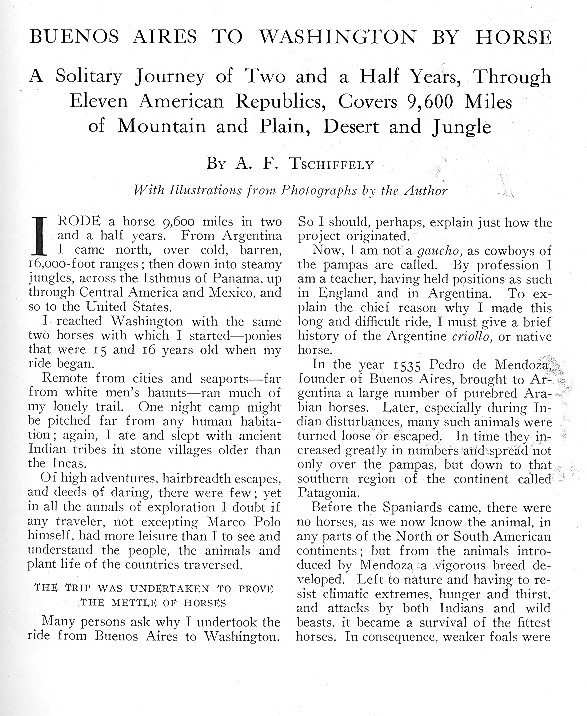
On July 8, 25-year-old journalist Filipe Leite straddled one of his two horses and rode out of the Calgary Stampede under the escort of the Royal Mounted Police to start a 10,000-mile, two-year-long, 12-country journey that he hopes will end on his family’s ranch in Brazil. To understand the motivations for the cowboy's quest, it helps to start with his birth. His father, a cowboy, named him Filipe because it means friend of horses in Portuguese. He rode a horse before he could walk. As a little boy, his father told him the story of Aime Tschiffely, a Swiss schoolteacher who decided to ride from Argentina to New York City in 1925 on a pair of horses. Tschiffely rode over 16,000-foot mountain ranges, down into humid tropical jungles, and slept in Indian villages on his way through Central America. He didn't make it to New York City, but landed in Washington D.C., where he was greeted at the White House by President Calvin Coolidge in 1928. “Of high adventures, hairbreath escapes, and deeds of daring, there were few; yet in all the annals of exploration I doubt if any traveler, not excepting Marco Polo himself, had more leisure than I to see and understand the people, the animals, and plant life of the countries traversed,” said Tschiffely in an article about the expedition.
Leite said Tschiffely's journey inspired him. The Brazilian hopes to chronicle his expedition in a documentary. For now, he is resting in Delta, Colorado, roughly 1,000 miles from his start in Canada. He estimates it will take him another a year and nine months of riding before he arrives home at his family’s ranch in the small town of Espirito Santo do Pinhal, Brazil. “My horses will be retired there where they will enjoy fresh water and green grass for the rest of their days,” says Leite. “I'm giving the to my little sister. She's six-years-old now and will spoil them to death.”
We caught up with the cowboy by e-mail to find out a bit more about his journey.
WHO: Filipe Leite, a 25-year-old journalist who grew up on a ranch in Brazil.
WHAT: A 10,000-mile, 12-country journey from Calgary, Canada, to Espirito Santo do Pinhal, Brazil, on two horses. Leite travels an average of 20 miles a day and rides for four days straight before resting for two days. He sits in the saddle for about 10 hours a day, switching steeds when he needs to. In cities, he stays at rodeo grounds. In the country, he stays at ranches or farms. The toughest part of his journey so far has been a four-hour walk in the dark through Yellowstone. “I thought I was going to get mauled by a grizzly bear,” says Leite. “It was the worst.”
WHEN: Leite left Calgary on July 8, 2012 and expects to arrive at his family’s ranch in Brazil during the summer of 2014, hopefully in time for the Olympics.
WHY: “The trip was a lifelong dream. I hope to inspire others to follow their dreams. I want to show the world that we can do anything we put our minds to, even if it seems as insane as riding horseback 10,000 miles from Canada to Brazil. I also hope to show how we are all inherently the same—we all want to love and be loved. As a journalism graduate, I also knew I wanted to do a documentary within the Americas that focused on the dichotomy between rich and poor while also highlighting how similar we all are—regardless of religion, creed, or social economic background. Travelling horseback is perfect for this because it allows you to really live with the people in all of the places you pass through. Because I need help in order to find food, water, and the best routes for my horses, I am in constant contact with locals. They open their ranches and farms for my horses and I and while sitting around the dinner table with them I get to learn so much.”
Mike Overcast, operations manager of the Tordrillo Mountain Lodge in Alaska, prepares to lead a group of anglers down Talachulitna Creek armed with colorful flies and a bear gun. | Brett Prettyman/The Salt Lake Tribune)
I have had some pretty amazing birthdays, but I doubt any will ever top spending my 44th in Alaska. I've returned from a two-week trip to Alaska based around the Outdoor Writers Association of America annual conference. I serve on the board of directors of OWAA and "had" to be at the conference. Knowing that, I took some time to plan my first trip to the state I have dreamed of visiting since I was 10 years old.
The trip included many forms of transportation including: motor home, canoe, ATV, raft, float plane, train and helicopter. Lodging ranged from the aforementioned motor home to an off-the-grid spectacular cabin to a room at Chena Hot Springs Resort to the Tordrillo Mountain Lodge.
I spent nearly every minute of the two weeks with good friends Mark Freeman from Oregon and Reed Sherman, my fishing buddy who produced all the fishing and wildlife videos on the Tribune YouTube account. Along the way I hooked up with other good friends: Bill Klyn, Mark Taylor, Tim Zink, Chris Hunt and all my old and new friends with OWAA.
Through all the planning I could not have picked a more fitting end to the trip or a better way to spend my birthday on Tuesday. Mike Overcast suggested Mark, Bill, Tim and I join him for a float trip down Talachulitna Creek above Judd Lake, where the lodge he operates is located. The Talachulitna River, well known for producing big rainbows, starts out of Judd Lake right where the Tordrillo Mountain Lodge sits. We quickly agreed to the adventure as all of Mike's suggestions had reaped enormous fishing rewards to that point.
Tuesday morning we loaded the helicopter with inflatable rafts and our fishing gear and took the incredibly scenic flight to the launch. I took three steps out of the helicopter and landed on a grizzly footprint. I had thus far gone without seeing a bear in Alaska and I later told Mike I was both relieved and disappointed to not have seen one. I carried bear spray during the entire trip in Alaska - well, not in the motor home or in the train - and Mike was sporting a huge pistol during our float. It was tucked in a holster on his chest along with a colorful assortment of flies.
The first spot we stopped to fish the creek was loaded, and I mean chock full, of sockeye salmon. The banks on both sides of the river were stamped with bear tracks bigger than my face. We soon started to spot big piles of what I called fast-food remnants from the bears. Not bear scat, but big piles of partially consumed sockeye littered the banks. I figured if I was ever going to see a bear in Alaska that this was the time and that it was more than likely to be a close encounter.
We fished through and behind the sockeye seeking Dolly varden and rainbow trout that collect with the salmon to dine on the eggs leaking out or being laid. I found it a bit hard to concentrate with decades of grizzly attack stories seeping out of my brain. Nonetheless, I still managed to hook up with big Dollies and 'bows. A little farther down the creek we ran into our first log jam. It wasn't too big, so we just pulled the rafts over the log and crawled back in to continue on our way. Mentions of Lewis and Clark were shared and laughed about, but any similarities disappeared when we hit the next log jam.
We hit a good fishing hole and after we started casting Mike walked down to explore the creek. He came back a few minutes later, grabbed something out of the raft and headed back downstream. My fears of encountering a grizzly, at least for the next few miles, faded as Mike fired up the chainsaw and jumped on the logjam. Five minutes on the chainsaw easily equalled a hour's worth of my measly "Hey Bear!" call. We ended up using the chainsaw several times saving my voice from getting hoarse from all the yelling.
I have never felt so far away from the chaos of the world as I did on Tuesday. Feeling that way cleared my mind in a way I've never experienced and lifted me spiritually. I already crave to experience that feeling again.
Back at the lodge that evening the staff brought out candles, luckily only three, on dessert and my buddies, the other visitors and the folks at Tordrillo Mountain Lodge sang happy birthday to me. A birthday never tasted so sweet, although I must confess that I really was missing my family at that point.
Flying back to Anchorage in the float plane on Wednesday I scanned the terrain below us very carefully for a bear. I was suddenly desperate to see one, but we hit the outskirts of town with no luck. I guess that means I'll have to return to Alaska.
By any historic measure, German U-boat activity during World War II in the North Atlantic was a persistent and deadly fact of life.
But the German torpedo attack on a 412' steel-hulled cargo ship was particularly galling: not only was it a British ship but it also was most likely carrying in excess of 2,000 silver bars.
Just over 70 years after the SS Gairsoppasunk out of sight about 300 miles from Galway, Ireland, a recovery operation conducted by Tampa-Fla.-based Odyssey Marine Exploration has retrieved some 48 tons of silver bullion at a depth of roughly three miles.
Conducting the operation under contract with Britain’s Department for Transport, Odyssey Marine has so far retrieved 1,203 silver bars that have since been transported to a secure facility in the UK. The company will now launch a subsequent Gairsoppa recovery operation to hopefully pick up what it left behind. It is scheduled to be completed by the end of this year.
“The success of this record-setting project proves that the Odyssey team can surgically cut through secure areas of a modern shipwreck to recover cargo in the extremely deep ocean with the use of robotics,” said Odyssey President and COO Mark Gordon. “By proving this we can now entertain a host of other shipwreck projects that were previously unattainable due to depth.”
The recovery operation was officially launched in May, coming on the heels of a series of reconnaissance dives conducted by the company earlier in the year.
Odyssey officials now hope to buttress the 1.4 million-oz. Gairsoppa recovery with the retrieval of an estimated 600,000 ozs. of silver onboard the SS Mantola — a second shipwreck recovery operation that is expected to reach its conclusion late this autumn. The Minolta was a 450' British-flagged steamer, which set sail from London on Feb. 4, 1917, carrying passengers and cargo — including a shipment of silver — to Calcutta, India. On Feb. 8, 1917, The vessel was torpedoed by a German submarine.
In a statement, Odyssey CEO Greg Stemm, said, “Our success on the Gairsoppa marks the beginning of a new paradigm for Odyssey in which we expect modern shipwreck projects will complement our archaeological shipwreck excavations.”
The operation has been framed by a public/private contract between Odyssey and the British government, which requires the company to bear the risk of the work while also retaining a percentage of the net saved value of the Gairsoppa haul after expenses.
Gordon contends the early success of the Gairsoppaoperation is proof that “our government partnership model works.”
“We took the risk of the search and recovery on this project,” said Gordon, “and will be rewarded with the repayment of expenses plus 80 percent of the net salved value of the silver recovered.”
The British government, meanwhile, “will retain 20 percent of the net salved value at no risk or expense to their taxpayers,” added Gordon.
Odyssey specializes in what is described as “archaeologically sensitive exploration” and the global recovery of deep-ocean shipwrecks.